
The inner narrator often sounds like an endless commentary: looping worries, quick self-criticism, and background chatter that follows us through the day. It can make simple tasks feel heavy and pull attention away from the present.
Rather than trying to stop every thought, this approach shows how to change your relationship with them. The goal is not a blank head but steady awareness and calm. Expect to practice returning to the present moment more often than to “win” a battle.
We’ll outline a simple seated practice, clear steps for what to do when thoughts arrive, and quick techniques for busy or restless days. Many people find this practice supports reduced stress and less anxiety over time.
Beginners: a busy mind is normal. Short, regular sessions can fit into work, family, and commutes in the United States. This article will show how to start in minutes and build a sustainable routine for daily life.
Why Your Inner Narrator Gets Loud and What Meditation Changes
Your inner narrator often grows louder when routine takes over and attention drifts. The brain runs many actions on autopilot, so the mind fills empty moments with commentary instead of quiet. This is normal, not a flaw.
Mindfulness is not about wiping the slate clean. Mindfulness meditation trains you to notice what’s here and choose where to place your attention. You don’t erase thoughts; you see them and return to an anchor, like the breath.
“One breath, and I’d be gone.”
This quote from Sharon Salzberg shows how fast the mind wanders. A simple driving example helps: you get home on autopilot and then realize your narrator was planning tomorrow’s meeting. That pattern repeats.
With regular practice, you build awareness that you’re thinking and gently bring attention back again and again. Over time you pause before reacting, catch spirals earlier, and gain space to choose your next step. This is a steady process that gives people a calmer way of responding to the day.
What Meditation Is and Isn’t
Think of the practice as a simple skill: notice where your mind goes and gently bring it back. A clear, usable definition is this: meditation practice trains attention—often by focusing on the breath—so you can see thoughts and return without judgment.
This process does not judge you. It isn’t a personality test or proof you’re failing at life when your mind is loud. It’s also not a demand for perfect calm. The goal is steady attention, not perfection.
Common forms include mindfulness meditation, mantra work, body-centered scanning, emotion-focused sessions, movement-based approaches, and visual practices. These different forms suit different goals: calmer self-talk, better focus, stress support, or sleep.
Many traditions—Buddhist, Christian contemplation, Sufi, Taoist, Transcendental, and yoga—gave rise to these practices. You can be religious, spiritual, or neither and still use modern, nonreligious guided meditation as a friendly entry point. Audio guides give a steady focal point and reduce self-judgment.
Choose a form meditation style that fits your aim and life. That way, you pick a sustainable path and build a practice that supports daily calm and clearer focus.
Set Up for Success Before You Sit
Start by making the setup simple so your first sessions don’t feel like a chore. A modest plan helps you actually practice on a busy day. Pick a short window and protect it.
Pick a realistic time window
Set a timer for 5–10 minutes to begin. Short minutes add up, and a fixed limit makes the practice doable on a weekday.
Choose a steady posture
Prioritize a stable seat that protects the body. Use a chair with feet on the floor, a cushion for cross-legged sitting, or kneel if that feels better.
Simple habits that stick
Decide on one anchor — usually the breath — and gently return attention each time you drift. Place a cushion where you’ll see it or add a recurring calendar reminder.
If you think “I don’t have time,” remember a few focused minutes can retrain the mind and lower reactivity. Try meditating right after brushing your teeth or before opening email to remove friction and keep the habit alive.
Meditation for Quieting the Inner Voice
Begin with a simple seated routine that uses the breath to steady attention and soften the inner commentary.
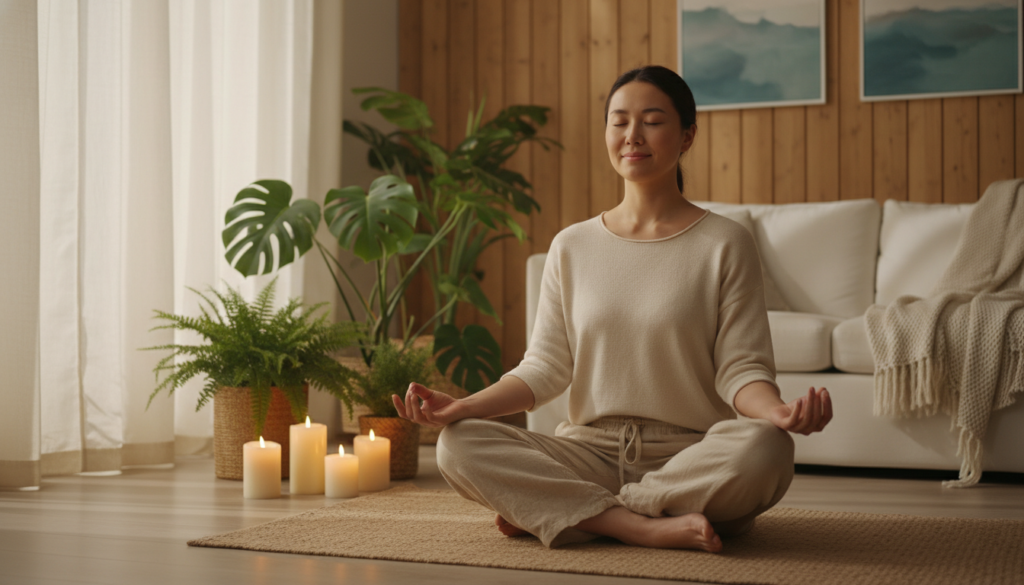
Use the breath as an anchor for the mind
Sit tall and notice where the breath feels clearest — nose, chest, or belly. Keep a light focus there; don’t try to control it.
Notice body sensations without judgment
Scan contact points: feet on the floor, hands on thighs. Let the body steady you and observe any simple sensations.
When thoughts show up, label them and gently return
If a narrator starts, name it — planning, worrying, self-criticism — then bring attention back to the breath. No debate, just a friendly return.
Close the session with kindness, reflection, and re-entry into your day
Open your eyes softly. Notice sounds, feelings, and the body. Take one full breath before reaching for your phone. This pause helps the practice carry into the day.
Techniques to Try When the Narrator Won’t Stop Talking
If sitting still feels impossible, use these targeted techniques to carry calm into real life. Think of this as a toolbox for days when a seated practice won’t hold your attention.
Body scan for head-to-toe awareness
Start at the toes and move slowly: toes → feet → legs → pelvis → abdomen → back → chest and shoulders → arms and hands → neck, face, head.
Notice sensations, don’t fix them. If the mind wanders, return to the last body part. If you drift toward sleep, reawaken and continue.
Walking for restless energy
Walk at a natural pace. Pay attention to lifting and falling of each foot. Optionally count steps to ten, then repeat.
Use walking meditation during a lunch break, in a parking lot, or around the block. Stay aware of traffic and uneven ground for safety.
Compassion and repetition
Try loving-kindness: silently repeat phrases like “May I live in safety” and “May I live with ease”. Notice resistance, return kindly.
For repeating loops, use a short mantra or an emotion-centered practice that focuses on a single feeling, like kindness. Experiment with one form for a week and reassess. These practices offer a gentle way to reshape emotions and quiet the narrator over time.
How to Work With Thoughts, Feelings, and “Brain Chatter” Without Fighting
You can learn to meet mental noise with curiosity instead of resistance. This approach trains your awareness and attention so the brain stops driving you unconsciously.
Common distractions and what to do in the moment
Typical distractions: itching, noise, sleepiness, planning, worry, impatience. Use a quick three-step habit: notice → label → return attention.
Example: if you itch, pause to notice the urge, label it as itching, then either scratch or return to your anchor. That small pause builds your ability to respond.
Breathing concerns, eyes open vs. closed, and other beginner roadblocks
You don’t need to change the breath unless you choose a breath technique. Breathe naturally; comfort is the rule. Only worry if breathing actually stops.
Eyes open or closed both work. Open with a soft downward gaze if you feel sleepy. Close your eyes if external distraction is strong. There are no hard rules — pick what helps you stay present in the moment.
If stress or anxiety spikes, allow sensations and anchor to a single safe point (a sound, the breath, or body contact). Let feelings come and pass; this reduces stress over time.
When the inner voice says, “I’m bad at this,” treat that as another thought to notice, not a verdict. Catching the drift is progress: awareness itself is the trained skill.
If you struggle alone, try guided audio, a class, or practicing with a friend. Many people find group formats boost consistency and confidence, which helps the practice stick.
Benefits You Can Expect With Consistent Practice
When people practice a little most days, the gains add up in ways you can notice quickly. Expect changes that appear over weeks: steadier reactions, fewer spirals, and small shifts in sleep and health.
Stress and anxiety support backed by research
Research reviews show clear signals: a 2017 review of 45 studies found lower physiological markers of stress. A meta-analysis of roughly 1,300 adults found programs may reduce anxiety symptoms.
Focus, attention span, and brain changes
Studies using EEG and fMRI report measurable brain changes: stronger networks tied to concentration and emotion regulation in regular practitioners.
Amishi Jha found that 12 minutes, five days a week can protect and strengthen attention — a practical target for busy people who want less inner chatter during work and conversations.
Sleep, blood pressure, heart health, and mind–body resilience
Mindfulness programs can ease insomnia severity and help racing thoughts at night, improving sleep onset and continuity.
A meta-analysis of 12 studies (~1,000 participants) linked regular practice to lower blood pressure. Lower fight-or-flight signaling reduces strain on the heart and supports overall blood health.
Reviews also find reduced pain and better quality of life. In short, these changes improve mind–body resilience and a person’s ability to bounce back from stress.
“Small, steady practice builds lasting ability to notice and respond rather than react.”
What you might notice first: more awareness of spirals, slightly calmer reactions, and easier resets after a stressful moment. Benefits often begin in minutes-per-day routines and grow with consistency.
Conclusion
A small, steady habit changes how you respond to thoughts without trying to erase them.
Make a simple loop your daily guide: sit → breathe → notice wandering → return → close with kindness, and repeat. This practice is straightforward and hard at the same time, but it works when you show up.
Try 5 minutes a day for the next seven days. Pick what fits your schedule and stick to that time so momentum builds.
Quick decision map: seated breath for most days, walking for restless energy, body scan for tension, loving-kindness for harsh self-talk. Use these techniques as needed.
The real benefits come from repetition, not a silent mind. Your mind will keep generating thoughts, but you can train the way you respond — one friendly return at a time.
Practical next step: choose a cue (after coffee, before email, or after brushing teeth) to make meditation automatic and begin today.